PART A – Extend your own arts practice
Planning, idea’s and development of project
What? – Photography
But what kind of photography? – Nature, Landscapes, Human landscapes
Why? – I love being outside I like nature, I like the appearance of landscape photography
Where? – Alderley Edge, North west Manchester.
How can this be a project? – I want to look at techniques, styles, editing, all things that make up high class Landscape photography, history of landscape photography + current landscape photographers.
Equipment? – Nikon D90, Tripod.
what could I get to help with my images? – Filters for the lens, Neutral density filters, shutter release, wide angle lens.
I am shooting with an Nikon 18 – 105mm lens, the numbers represent the Focal length of the lens, 18mm is considered a wide angle focal length for a 35mm camera , 105mm is not a a wide angle focal length, below are two image that show the difference between wide angle and non wide angle!

This is an example of a wide angle image, as we can see there is more in the image, particularly in the foreground, this image would have been shot with a focal length below 18mm

The non wide angle image, lacks the sense of depth and scale that the wide angle shows us, it doesn’t have as much in the image and also it tends to feel cropped and restricted, this image could have been shot with anything above 18mm as a focal length.
Short Project –
Shoot a couple of images that are a great example of Wide angle, these can be of anything in the local area.

This image I have taken using the wide angle focal length of my camera lens, this means the lens would have been set to 18mm in focal length and this allows for a lot of information to be captured with the foreground of the image.
Current Landscape photographers, and what contemporary landscape photography looks like.
Richard Mosse –
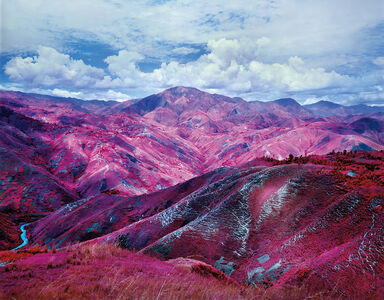
He is an Irish documentary photographer, focusing on landscapes of conflict, he uses infrared photography to capture these scenes. He combines the people of the landscape with the physical landscape.
I like how open the image looks and how the colours go together really nicely, so as the image was shot in infrared the colour have been altered, a similar look can be achieved in photoshop by simply adjusting the hue.
here is an image where I have experimented with the Hue and saturation in the image, to give it a similar look to Richards.

Ted Gore –

He is an American photographer based in southern California and is known for the very personal style of his landscapes.
I like how the sky is very colourful and how it is reflecting off the ground, the image is a good example of leading lines, I like how these lines lead the eye to the landscape scene in the background.
My Shoot
Inspired by the idea of Wide angle photography and large distances, I have completed a series of images in both Wales and Bristol, a few of these images I would like to edit and present as final images in a potential exhibition or online showing.


Edited images from Wales/Bristol shoot
Below are the edited images from the series that I shot in Bristol and wales, the Images have been edited in photoshop.

In the images I have added contrast and increased the brightness, I feel that this has improved the light and made the images more dramatic in terms of the colour.

I will want use these images as a starting point for an exhibition of landscape photography, looking at the landscape untouched by people.

The title of the photo project now based on the subject will be “Abandoned”.

Over the next few weeks, I will running with this project and working on more images and video that explore the idea of Abandoned landscapes.
Art within the landscape of photography’s role in capturing it.
the landscape can be used in many ways to create interesting and striking artistic images, one such artist who works in this way is Andy Goldsworthy, he uses materials from the landscape to create fascinating sculptures, he then uses photography to document this event.
Andy Goldsworthy –


Andy Goldsworthy is an English sculptor, photographer and environmentalist who produces site-specific sculptures and land art situated in natural and urban settings. He uses surrounding materials whilst on site to create interesting sculptures.
This week I will be looking at creating a series of images inspired by Andy Goldsworthy, I will spend time in the local woods creating a piece of sculptural art which I will then use photography to document.
PART B – DEVELOPMENT OPPORTUNITIES WITHIN THE WIDER ARTS SECTOR
The field of photography can lead to many area’s for me in future, such as:
Photographer
Commercial and Advertising Photographer
Corporate Photographer
Editorial and Press Photographer
Fashion Photographer
Fashion and Photographic Stylist
Fine Art Photographer
Wedding Photographer
Portraiture Photographer
Medical/Clinical Photographer
I am particularly interested in the role of a fashion photographer, Fashion photographers are responsible for how clothing is presented in advertising campaigns, catalogues and fashion magazines. They work closely with designers and fashion houses to ensure they are portraying the desired image for the brand. They work in studios or carry out shoots on location.

I have been interested in fashion photography for a while, I think it looks really interesting and how you get to work with different people and different styles of clothing and different backgrounds every time.


1 Fashion photographer that you like.
Lindsay Adler –

PART C – RESEARCH ADVANCED PRACTITIONERS AND REVIEW ARTS EVENTS
I am looking into well known landscape photographers as my primary research for this project:
Elia Locardi –

Elia is an internationally renowned landscape photographer, he works across 65 countries and has flown a total of 2 million miles in his photographic journey, he is working on multiple projects such as “Location independence, I like the use of his colours, and how the colours in his images appear, they are different to many other landscape images.
Alexandre Deschaumes –

Alexandre is a French photographer, he focuses his work primarily on nature and the elements, he is influenced by Ansel Adams, and Vincent Munier, I like the sense of style and the elemental aspect of his work, the use of fog and cloud creates a creepy dramatic feel.
Ansel Adams –


Ansel Adams was an American photographer who used large format cameras to capture images of the Yosemite national park, I like the sense of scale and depth that he gets in his images, I like the use of black and white and the drama that that creates in his images.
Ansel Adams Biography
Who? Ansel Adams was an American photographer, born in San Francisco in 1902, he worked part time as a photo finisher in San Francisco whilst capturing images of the Yosemite national park.
what? Ansel Adams was a landscape photographer, who focused primarily on the Yosemite national park, he used black and white photography to capture these landscapes, he worked on occasion with the urban landscape and portraits.
why? Ansel Adams was a conservationist, he used photography to highlight the importance of our environment, he wanted to document the landscape for future generations.
when? At age 12, he was given his first camera during his first visit to Yosemite National Park. He developed his early photographic work as a member of the Sierra Club. He was later contracted with the United States Department of the Interior to make photographs of national parks. For his work and his persistent advocacy, which helped expand the National Park system, he was awarded the Presidential Medal of Freedom in 1980.
how? Ansel Adams used old analogue methods of photography, he used an old 5×4 camera and black and white film and chemistry.

Brief Ansel Adams project
Consider conservation photography and create a short series of images in this style that says something about conservation.
Conservation Photography –
Photographing nature is not an easy task. It’s early mornings, lots of patience and a willingness to travel to the most unusual of locations. Nevertheless, it’s important, creating connections for people with places that they know exist but might find difficult to envisage.
By documenting places, people and wildlife, conservation photography creates a narrative for nature. More than that, it opens a dialogue about human interaction with it, and therefore invites positive changes in how we do so moving forward. Photographs of mountains inspire awe and a sense of freedom, photos of juvenile animals make us feel wistful, and those of degradation inspire anger and sadness; all the same emotions and understanding we would experience first-hand.
The truth of photography is not just in the moment a frame has captured, but in the reality of our perception. Through this, conservation photography educates as much as it entertains, demanding that we look not just because we should, but because we need to know this is the world as it is.

The Secret life of the forest photography event

On Wednesday the 9th of June, between 6 and 7 I will be attending the online photography conference ~”The secret life of the forest” ran by the Bristol zoological society, the conference will look at ways in which photography is used in conservation, and how the zoo use techniques to capture their images, during the event I will take notes and use these to write a review of the event for my blog.
Event review
I attended the “Secrets of the forest photography event” I found it quite boring and dull, I thought it would of been better, I didn’t take much away from it in terms of photography knowledge, as the session tended to be more focused on camera traps and understanding conservation than the actual act of photography.


PART D – FORM AND COMMUNICATE A VIEW ON AN ARTS ISSUE.
Is there enough photography education support in the home educated community….?
As a member and student within the home educated community, I feel that there isn’t enough photography education in the home educated community, I feel like we should have more photography education available to us as home educated students, at the minute we only have google, YouTube, and private educators to help us learn about this art form. Although this is all well and good, it does leave us having to build and collect our own equipment, such as camera’s studio lighting, tripods etc. which can be come very costly, I feel that one way in which we could fix this issue would be to build and develop community ran and organised photography studios, where equipment and studio space can be hired to allow us to explore photography further and at a much more affordable cost to us.

From the research I have made, I haven’t been able to locate any community ran or available photography studio’s, I will work out a plan for how and where I would build my photography studio and what i would need for this.

To build my photography studio I would need a big enough space for lights, cameras, different backgrounds and the people I would be photographing. I would probably try and get a space in Wilmslow that’s affordable and make sure it has enough space for parking for people who want to use the studio and for the people who will be photographed. If people wanted to use the studio they can, they would pay a monthly fee and they would get to use the studio any time they want, they would be able to access all the equipment within the studio and use it for both commercial and personal work, the studio would offer lessons and information on how to use the equipment and would also encompass a exhibition space for the studio members.

I feel that this would greatly support photography and art education in my area, especially in regards to the home educated community.

 justaddhoney